A Utensil Drawer That Opens on the First Pull
Measure the space the drawer really offers and arrange it so the utensils used during cooking stay easy to reach and put away.
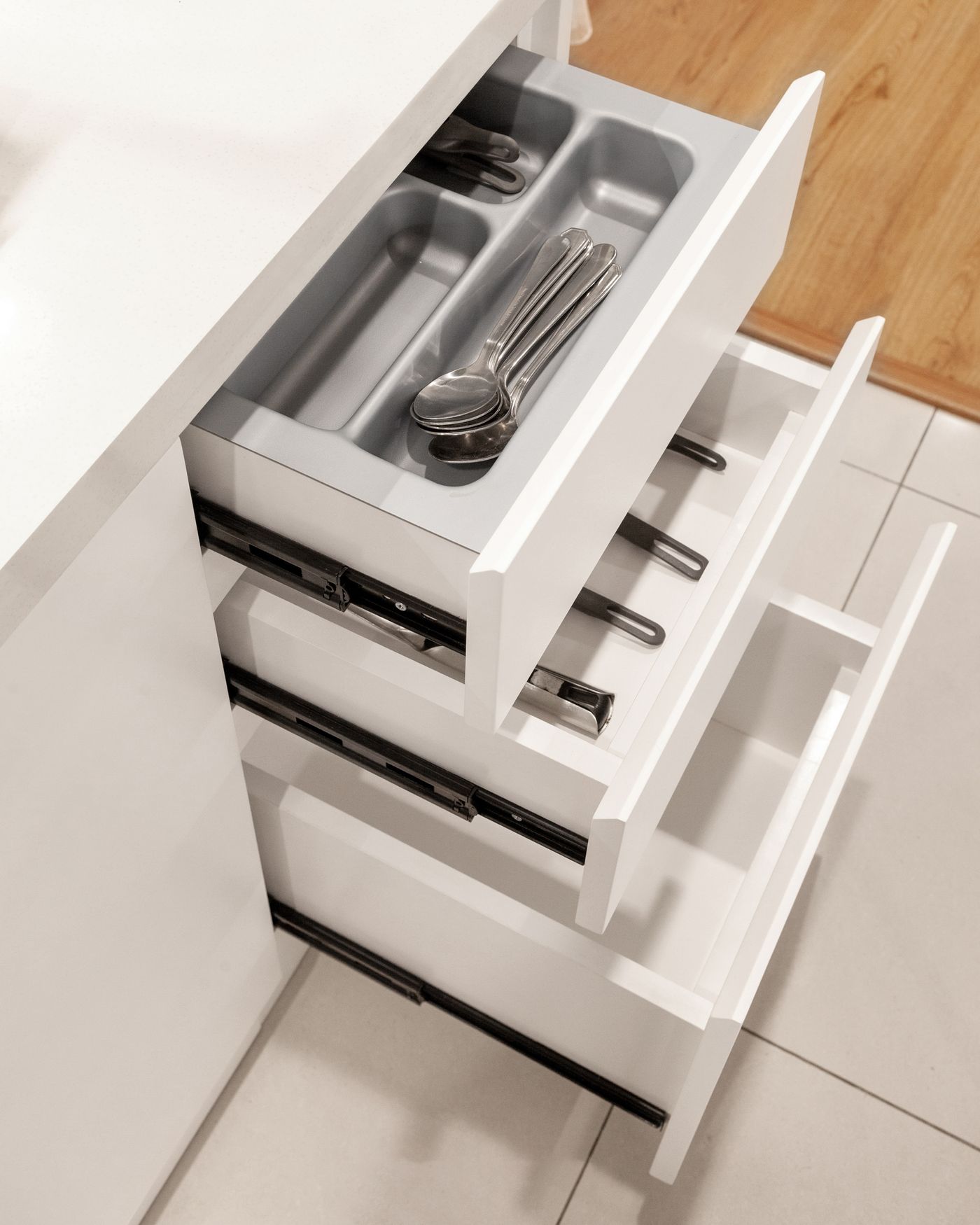
A utensil drawer usually has a particular tool that stops it opening. The whisk hooks under the frame, or a long turner twists upward when the drawer shuts. You can make room by moving that tool. It is also worth asking why the rest of the drawer needs to move every time you want a spoon. A drawer works well when it gives you a predictable motion with your hand. Open it, reach to a familiar area, take the tool, and close it without tucking anything back in. Use that simple motion as the test of a new arrangement, and it will tell you which dividers, tools and compromises belong.
Start at the place you use each tool
Notice where you stand when you take out a utensil. If you reach for measuring spoons beside the flour and the scale, it may be inconvenient to keep them next to the stove. Tongs and a turner are likely to earn space near a cooking surface, positioned where you can reach safely without leaning across heat. If the same drawer holds serving spoons used once a week, put them further from the front or move them to where you set the table. Think about putting tools away as well as picking them up. A drawer that is easy to use but hard to refill after washing will slowly become a place where objects get dropped into whatever space is open.
Watch two different meals. For one, imagine assembling a sandwich and putting utensils away after a quick wash. For the other, consider making a meal with a pan, an oven dish and several tools in use at once. Find the tools common to both tasks and the ones that get in the way between them. A flexible scraper might earn a front slot if you use it almost daily. The long grill fork may never be needed in the kitchen at all. Move out the things used in another location before deciding how many compartments the drawer requires. Buying an insert for the contents as they stand tends to preserve habits you meant to change.
Sort worn tools separately. Inspect for handles that turn loosely, rough or damaged working surfaces, and any material that is no longer suitable for the way you cook. Repair or replace what needs attention rather than giving it another slot. Check which duplicates work well together. Two similar spoons may both be needed when two dishes are cooking, while four almost identical bottle openers take up room even on an unusually busy day. Choose the version you reach for when they are all clean. Keep unusual tools if you use them, but give the long, bulky ones a home that takes their actual size into account.
Measure the opening as well as the empty box
Take the tools out and measure the inside width and depth at the floor. The upper opening can be narrower than the floor if a runner, frame or join takes up space. Find the usable height with the drawer closed. If you cannot see it directly, check the cabinet opening and use a light piece of folded cardboard to check for interference, keeping fingers clear of pinch points. A low tray that fits under the frame by itself can still catch after a tall whisk has been put into it. Measure the utensil and the tray together. Compare the motion near the back with the motion at the front. Some drawers don't extend far enough to give you full access to their deepest area.
Open the drawer fully and look at it as a user would. Where can the whole hand come down to pick up a small item? If the rear of the drawer sits under the counter, a deep narrow tray there may be difficult to use even though it fits. The back can hold a few longer tools you slide out toward you or an occasional item you can remove by the handle. Leave any part required for the drawer's hardware clear. Don't force the drawer shut during a fit test, and keep the contents within its load rating. A drawer that has started sagging or moving unevenly should be repaired before you add more weight.
Try laying paper strips on the floor of the drawer to represent the available compartments. Put the real tools on the paper. Arrange longer things along the longer dimension, with handles where you can reach them. Allow room for fingers at the sides of items you lift out vertically. For a small spoon in a deep narrow compartment, a slightly angled position might make it easier to grab without having to pick up everything else. The sharp or pointed parts of tools should be protected and appropriately stored. Use a suitable separate holder for knives, with blades secure and handles presented where expected. Plan for child access as appropriate to the household.
Build a few compartments with clear roles
Many useful drawers need one section for long tools, a shorter space for small tools, and a couple of open spaces with straightforward jobs. The narrower the divider layout, the more precisely an item must go back. That can work for a pair of measuring spoons that are always clipped together. It is less practical for several differently shaped tools that need to lie loosely in a common area. Choose a compartment by the hand movement required to put things away. If there is only one angle at which a turner fits, a visitor will probably set it diagonally across the top. Leave it enough room to go in from a natural direction.
If you use removable inserts, look for pieces that hold their position when you close the drawer normally. Test a tray with the heaviest tool in its front corner. A smooth insert can slide into a gap and trap a utensil against the side. A compatible non slip layer, or a well fitted arrangement, may help. Make sure you can lift the pieces out for cleaning without tugging on the drawer or damaging its finish. Avoid tall ridges where you need to reach across a divider. If choosing a spring loaded or expandable product, use it only in a suitable drawer and follow its instructions. In a thin sided drawer, pressure or the wrong hardware can be an unwelcome trade for a removable organizer.
Think about crumbs and drips before installing the arrangement. Tools should go back clean and dry, but ordinary dust and debris will still get into the corners. An insert that lifts in one piece is quick to empty. A set of small trays lets you clean the compartment that needs attention without removing every tool. A deeply textured surface can grip, but it may be more difficult to wipe than a plain finish. Check care instructions for your drawer and the materials you use. Keep the simplest arrangement that supports the way you cook. A small divider can be useful for separating two sets of spoons, but a whole row of narrow gaps can add a lot of cleaning without making anything easier to find.
Deal with the two objects that don't fit
Some shapes are better in a different location. A ladle with a deep bowl may be too tall even when placed on its side. A long rolling pin may consume so much floor space that it forces several frequently used utensils into a pile. Look for a nearby shelf or another suitable storage position where the object can lie flat or stand securely. An upright container near the preparation area can hold a few broad or tall tools, provided it stays stable and clear of heat, splashes and routes. Test it with the tools removed in different orders. An overloaded upright container repeats the drawer problem at counter height.
Make sure pieces of a tool stay where they can be used together. If a handheld grater has a cover, put the cover on as intended before storage. A set of attachments that belong to an appliance may be easier to find in one labelled container with the appliance than spread through the busiest drawer. Keep the small pieces a person actually needs in the drawer, but give the rest a distinct place. If you still have too many items, try a modest limit for that category and leave the most useful tools at the front. You can keep a few seasonal pieces elsewhere until the occasion that needs them, without confusing them with the tools used on most nights.
Test the reset after washing up
Ask another person who uses the kitchen to make a snack, put the tools back and close the drawer. You do not need to watch. Open it later and see what moved. If tools keep lying across the front of their compartment, perhaps the handle area is too far back. If two compartments attract the same items, combine them or give them clearer uses. Try washing several of the common utensils on the same night. A drawer with a reasonable place for each tool when half are out can fail once everything is dry and back in it. Check the drawer both full and partly empty, because the movement of an insert can change with the load.
Live with provisional dividers for a week. Make one improvement at a time so you can tell which adjustment helped. When the right arrangement is in place, you won't have to remember how the drawer looks on a good day. You'll have a clear grip on the handle of the spoon you came for, and space to put it back when the washing up is done. There may still be a handful of mismatched turners or an old favourite with a worn handle. How easily the drawer opens the next time you are holding a pan tells you more about the arrangement than how uniform it looked when it was first put together.